
Issue # 5
The longest newsletter yet with a new essay, thoughts and a lot of quotes
New Essay
I wrote a new essay on the problem of implementation and adoption of AI in big companies
On large talk
I logged into LinkedIn to post about this Substack and while I was there I texted this specific person telling them they should write more. And because their response was to say that they didn't know if they're that good, I tried countering imposter syndrome. This was a second or third interaction with the person but instead doing a normal counter I launched into a long tirade and shared an entire text from a blog post in the chat skipping surface level conversation for the the kind of stuff that you say to people you have already known for a while. This is on average not a great idea. But I personally speedrun interactions and skip small talk. The benefit of this is that I get to be unapologetically myself and after an interaction of this type, if the person finds it digestible they talk more and if they don't, they talk less. Which saves me from the drudgery of dozens of conversations about nothing before finding out that we don't like talking to each other.
Another benefit of this is that most your interactions start to become of this type as people start skipping surface level conversations with you. This is an example from an entirely different conversation where someone I hadn’t talked to in a while reached out like this last week
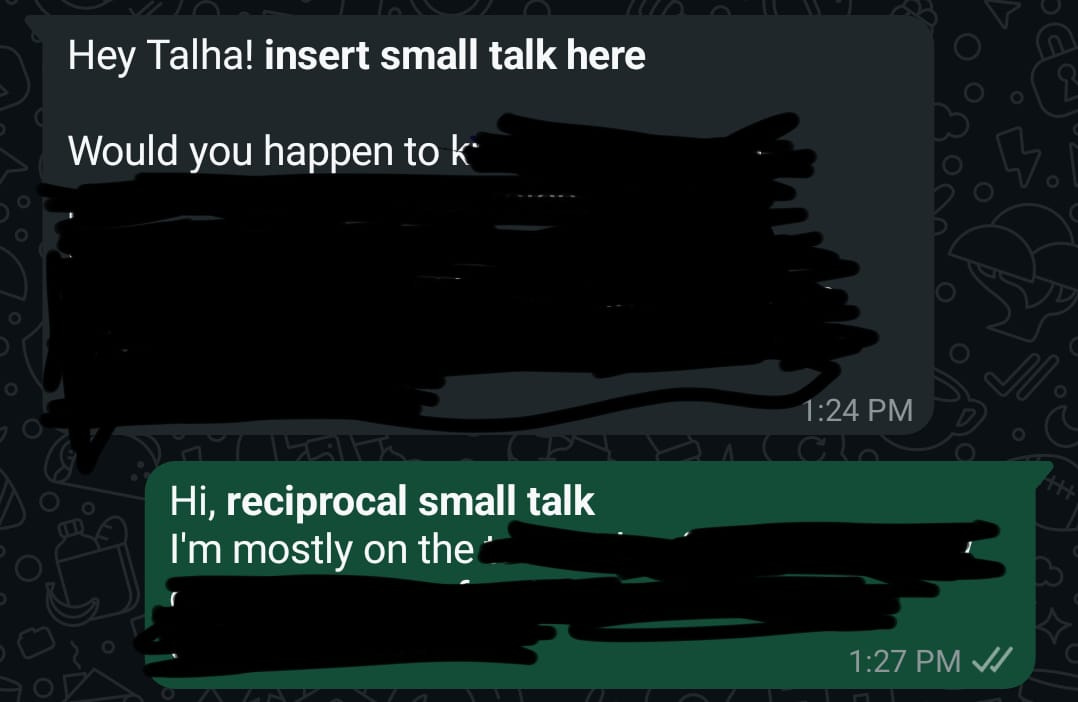
And it's very important to me that I prune my interactions to find the people who I'd like talking to and who would like talking to me because I don't like talking to most people
Most people try to put up with these small talk situations because they people don't like burning bridges and alienating others. But I care less about burning bridges. Someone from a VC firm suggested I remove the "meh" I have on my LinkedIn for Antler section because it might hurt my chances with other VC firms. The "meh" is still there.
Thought
Companies should treat meetings like court marriages with only the couple and officiator but they treat them like South Asian weddings where everyone who is not even remotely related to the couple has to attend.
Quotes from a PG article
"It seems to be a constant throughout history: In every period, people believed things that were just ridiculous, and believed them so strongly that you would have gotten in terrible trouble for saying otherwise.
Is our time any different? To anyone who has read any amount of history, the answer is almost certainly no. It would be a remarkable coincidence if ours were the first era to get everything just right."
"If you believe everything you're supposed to now, how can you be sure you wouldn't also have believed everything you were supposed to if you had grown up among the plantation owners of the pre-Civil War South, or in Germany in the 1930s or among the Mongols in 1200, for that matter? Odds are you would have."
"What can't we say? One way to find these ideas is simply to look at things people do say, and get in trouble for.
Of course, we're not just looking for things we can't say. We're looking for things we can't say that are true, or at least have enough chance of being true that the question should remain open. But many of the things people get in trouble for saying probably do make it over this second, lower threshold. No one gets in trouble for saying that 2 + 2 is 5, or that people in Pittsburgh are ten feet tall. Such obviously false statements might be treated as jokes, or at worst as evidence of insanity, but they are not likely to make anyone mad. The statements that make people mad are the ones they worry might be believed. I suspect the statements that make people maddest are those they worry might be true.
If Galileo had said that people in Padua were ten feet tall, he would have been regarded as a harmless eccentric. Saying the earth orbited the sun was another matter. The church knew this would set people thinking."
"When you find something you can't say, what do you do with it? My advice is, don't say it. Or at least, pick your battles.
Suppose in the future there is a movement to ban the color yellow. Proposals to paint anything yellow are denounced as "yellowist", as is anyone suspected of liking the color. People who like orange are tolerated but viewed with suspicion. Suppose you realize there is nothing wrong with yellow. If you go around saying this, you'll be denounced as a yellowist too, and you'll find yourself having a lot of arguments with anti-yellowists. If your aim in life is to rehabilitate the color yellow, that may be what you want. But if you're mostly interested in other questions, being labelled as a yellowist will just be a distraction."
"The trouble with keeping your thoughts secret, though, is that you lose the advantages of discussion. Talking about an idea leads to more ideas. So the optimal plan, if you can manage it, is to have a few trusted friends you can speak openly to. This is not just a way to develop ideas; it's also a good rule of thumb for choosing friends. The people you can say heretical things to without getting jumped on are also the most interesting to know."
On a slightly related note, I often get reactions from big accounts on X, but this was a first

Quotes from Confessions of an Advertising Man
(by Ogilvy)
In the modern world of business, it is useless to be a creative, original thinker unless you can also sell what you create
During the First World War a brigade major sent a verbal message back from the front-line trench to his divisional headquarters. The message started out as “Send up reinforcements, we are going to advance.” By the time it had been repeated from mouth to mouth through all the levels, it reached headquarters as “Send up three-and-four-pence, we are going to a dance.”
“it is equally difficult to tell a client that his product has a serious fault. I have known clients who resent such candor more than they would resent criticism of their wives.”
Interesting blog links
More on Large Talk
People may want deep and meaningful relationships with others, but may also be reluctant to engage in the deep and meaningful conversations with strangers that could create those relationships. We hypothesized that people systematically underestimate how caring and interested distant strangers are in one’s own intimate revelations and that these miscalibrated expectations create a psychological barrier to deeper conversations. As predicted, conversations between strangers felt less awkward, and created more connectedness and happiness, than the participants themselves expected (Experiments 1a–5). Participants were especially prone to overestimate how awkward deep conversations would be compared with shallow conversations (Experiments 2–5). Notably, they also felt more connected to deep conversation partners than shallow conversation partners after having both types of conversations (Experiments 6a–b). Systematic differences between expectations and experiences arose because participants expected others to care less about their disclosures in conversation than others actually did (Experiments 1a, 1b, 4a, 4b, 5, and 6a). As a result, participants more accurately predicted the outcomes of their conversations when speaking with close friends, family, or partners whose care and interest is more clearly known (Experiment 5). Miscalibrated expectations about others matter because they guide decisions about which topics to discuss in conversation, such that more calibrated expectations encourage deeper conversation (Experiments 7a–7b). Misunderstanding others can encourage overly shallow interactions.
https://www.apa.org/pubs/journals/releases/psp-pspa0000281.pdf
Random quote
(That is profoundly true)

Illusion of Depth
(from Experimental History Substack)
GO BLIND, GET HIGH, INVENT PSYCHOLOGY
Which brings us to psychology. No offense to the mathematicians, but most of us find people way more interesting than numbers. So why did we spend centuries studying numbers, while we've only recently started studying people?
Maybe it's because psychology is the domain with the deepest illusion of explanatory depth. You open your eyes and see stuff, and although this requires lots of complicated calculations and several anatomical miracles, it doesn't feel mysterious at all. You hear a song and remember the lyrics years later, and this seems totally natural. You and your spouse watch the same movie and have different opinions about it, and the explanation seems obvious: you're right and they're wrong. It's so easy to accept the wild workings of the mind at face value, or to generate ad hoc explanations for them, that you might never realize you have no idea how any of this works.
While philosophers have occasionally made these illusions deeper by spinning up spurious theories of psychology, I bet most of our illusion of explanatory depth for psychology comes preinstalled or is acquired quickly through experience. The brain's greatest trick is convincing you that it's not doing any tricks at all, blocking your conscious access to most of what it does and then giving you a perfectly reasonable account for what's going on behind the curtain:
Me: Hey brain, I notice that I can see stuff. How does that work?
Brain: Oh, there are things in the world, and then I peek out through my eyes and see them.
Me: Cool, sounds good.
Overcoming this expertly-maintained illusion requires a big push, which is perhaps why we didn't do it until a German guy stared directly into the sun.
Most histories of psychology as an experimental science begin with Gustav Fechner setting up a psychophysical laboratory in the middle of the 1800s. What those histories often fail to mention is that Fechner began as a physicist, but then he suffered a mental breakdown after going blind because he stared at the sun for too long.
He was trying to study afterimages, those glowing spots you get in your field of vision when you look at something bright and then look away. If you do that too many times, it turns out, you fry your retinas and get really depressed for three years. Fechner was completely blind for a while, and then he underwent treatment by moxibustion, which is where you put a weed called mugwort on someone's skin and then set it on fire. Besides leaving scars, this treatment somehow ruined his digestion, and he almost starved to death before a family friend figured out a way of preparing ham in a way that he liked; the friend said the idea came to her in a dream.
Fechner eventually recovered, but the experience turned him weird. Maybe it was the mugwort, which has psychedelic properties according to this seemingly-trustworthy website3, which would make sense, because when Fechner regained his sight, he acted like someone who had been doing a lot of shrooms.4 His first post-blindness project was a book about the mental life of plants. Then he decided to invent a new religion. From the biography that appears at the beginning of the English translation of his landmark Elements of Psychophysics:
Fechner's general intent was that his book should be a new gospel. The title means practically “a revelation of the word.” Consciousness, Fechner argued, is in all and through all. The earth, “our mother,” is a being like ourselves but very much more perfect than ourselves. The soul does not die, nor can it be exorcised by the priests of materialism when all being is conscious.
Fechner wrote seven books on the topic, but they never caught on, so he decided he should give his new philosophy a “scientific foundation.” For reasons not entirely clear to me now, he thought the most important thing to do was set up a laboratory and do things like: show people two lights that are almost equally bright and then ask them whether they can tell the difference between the lights. I don't know if this ultimately provided vindication for Fechner's philosophy, but he did discover that the “intensity of our sensation increases as the logarithm of an increase in energy,” and thus laid down, for the first time in history, a scientific law of psychology.
Fechner's sun-addled realization helped get people to start both a) wondering about how the mind works, and b) believing that you could study it empirically. He and his friends Ernst Weber and Wilhelm Wundt turned the University of Leipzig into the hot place to be for psychology, where they trained most of the prominent psychologists of that generation, who in turn trained most of the prominent psychologists of the next generation. A good chunk of experimental psychologists working today are descendants of Fechner and his friends, including me.5
Which is to say: the field of experimental psychology exists today at least in part because a German guy stared at the sun for too long.
experimental-history.com/p/on-the-importance-of-staring-directly
Most People
When I have a difficult subject before me – when I find the road narrow, and can see no other way of teaching a well established truth except by pleasing one intelligent man and displeasing ten thousand fools – I prefer to address myself to the one man, and to take no notice whatever of the condemnation of the multitude; I prefer to extricate that intelligent man from his embarrassment and show him the cause of his perplexity, so that he may attain perfection and be at peace.”
Changing People’s Minds
“You can’t expect someone to change their mind while you’re looking at them.
Here’s a thing that never happens: someone presents an argument that makes me go, “You’re right and I’m wrong! Please stand by as I change my opinion.”
Here’s something that happens all the time: someone presents an argument that makes me go, “No way, you’re wrong!” And then days or weeks later, I’ll be arguing with someone else, and I find myself deploying the exact argument that I previously rejected, which I’ve apparently started to believe without even noticing.
Which is to say: persuasion is 1/3 argumentation, 1/3 patience, and 1/3 low expectations."
experimental-history.com/p/12-baseless-opinions-about-having
Consider Subtraction
n a bunch of different studies, people tended to solve problems by adding things rather than removing them. For example, when people were asked to stabilize an unbalanced LEGO structure, they chose to add blocks—even when the simplest solution was to remove a block, and even when adding blocks cost them part of their bonus payment.
(This doesn’t happen in every single situation, of course. For instance, when you ask someone, “How would you improve this bacon, lettuce, tomato, and peanut butter sandwich?” most people say “Nix the peanut butter.”)
But this bias seems pretty widespread, and it’s hard to unsee it. Whenever I’ve been on some committee where we’re trying to solve a collective problem, every solution is some version of “There should be more.” More rules, more programs, more people doing more things. “Everyone should just work more, try harder, and be better.” Nobody suggests where all this additional effort is going to come from, as if everyone is sitting atop a secret stockpile of energy and we just have to browbeat each other into using it.
(See also: the infinite effort illusion.)
For instance, I often heard university administrators complain that nobody reads their email. Then one day I got 18 emails from the same administrator, all completely irrelevant to me, sent via a supposedly-vital “All Faculty” listserv that doesn’t let you unsubscribe.
In a world like that, reading all your emails is a sure sign you’re a psychopath. The way to get people to read your emails is to send fewer of them."
experimental-history.com/p/underrated-ideas-in-psychology-volume
Problem with statistics
"And so on, forever, consuming people's lives and millions of dollars in scientific funding along the way. All of this might look like very important scientific discourse, but remember that, no matter how long Dr. Down and Dr. Up argue, they are are never going to figure out what causes Down syndrome. Their problem is that they don't know what a chromosome is, and that can't be solved with statistics.
In fact, statistics are counterproductive here, because they create the illusion that there's a discoverable truth, and that the doctors are coming closer and closer to discovering it, if they can just figure out how to do the numbers right. That is to say: statistics can, paradoxically, prevent the accumulation of ignorance signals."
experimental-history.com/p/there-are-no-statistics-in-the-kingdom
Some other quotes
"if someone's like “Here's a microscope made out of numbers, go discover truth with it,” of course you're going to point it at tiny things. Do that long enough and you might come to believe, like I did, that only tiny things exist."
" I used to watch lots of neuroscience talks where the presenter would be like, “How do humans do this amazing thing?” and then they'd show a lit-up patch of brain and go “I found it, it's right here!” After the talk, one of my colleagues would always say, “Where did they think it was going to be? The elbow?”)"
"When used wisely, statistics can instead be like a trail of breadcrumbs that leads us out of the dark woods into the light of understanding. “There are more cancer cases in this town than we would expect by chance, what's going on there?” We might have to follow that trail of bread crumbs for a very long time, and there's nothing wrong with that. But the point is to leave the woods, not to spend our lives eating the crumbs. “Man shall not live on bread[crumbs] alone.”"
"Aristotle thought the purpose of the brain was to cool the blood, like a big meaty radiator. "experimental-history.com/p/there-are-no-statistics-in-the-kingdom
The Anarchist
"We have mRNA vaccines because one woman was so sure she she could make the technology work that she kept going for decades, even when all of her grants were denied, her university tried to kick her out, and her advisor tried to deport her.
We have CRISPR in part because some scientists at a dairy company were trying to make yogurt."
"In fact, whenever we find ourselves stuck on some scientific problem for a long time, it’s often from an excess of being reasonable. For instance, we don’t have any good treatments for Alzheimer’s in large part because a “cabal” of researchers was so sure they knew which direction Alzheimer’s science should take that they scuttled anybody trying to follow other leads. Their favored hypothesis—that a buildup of amyloid proteins gums up the brain—enjoyed broad consensus at the time, and anybody who harbored doubts looked like a science-denier. Decades and billions of dollars later, the amyloid hypothesis is pretty much kaput, and we’re not much closer to a cure, or even an effective treatment. So when Grandma starts getting forgetful and there’s nothing you can do about it, you should blame the people who enforced the supposed rules of science, not the people who tried to break them.
Likewise, even if we believe that science requires occasional irrationality, we hide this fact from our children. "
"Not only do we have useful research that breaks the rules; we also have useless research that follows the rules. You can develop theories, run experiments, gather data, analyze your results, and reject your null hypotheses, all by the book, without a lick of fraud or fakery, and still not produce any useful knowledge. In psychology, we do this all the time."
"People call it “Nobel Disease” when scientist-laureates do nutty things like talk to imaginary fluorescent raccoons, as if this nuttiness is a tax on the scientists’ talent. But that’s backwards: that nuttiness is part of their talent. The craziness it takes to talk to the raccoons is the same craziness it takes to try creating a polymerase chain reaction when everybody tells you it won’t work. It’s just an extremely specific and rare kind of craziness. You have to grasp reality firmly enough to understand it, but loosely enough to let it speak"
experimental-history.com/p/the-anarchist-and-the-hockey-stick
Blogging
As a genre, blogging is under-appreciated and under-theorized.
Most culture is produced by committee. Books, movies, music, video games, op-eds, scientific papers, etc. all have to pass through a gauntlet of editors, producers, reviewers, lawyers, and algorithms before they’re allowed to reach your eyeballs. Committees cost money, so they have to produce things that please enough people to turn a big profit, or else the committee will starve. And so they try to reduce variance, risk, and weirdness, and in raising the floor, they also lower the ceiling. The culture they produce is unlikely to offend or repulse, but it’s also unlikely to challenge or enchant. It’s usually fine and rarely sublime.
But the committees leave lots of weird little niches unfilled. They can’t contemplate strange ideas, they can’t countenance obsession or self-indulgence or idiosyncrasy, and they can’t risk confusing people or pissing them off. Unfortunately, doing interesting work often requires a dash of all those things.
That’s where blogging comes in. When you don’t have a committee to feed, you can afford to be weird. You can allow yourself all of the excesses that are necessary for producing something that rearranges the furniture in someone’s mind. The lack of quality control means that blog posts are usually bad, but they’re occasionally magnificent. That’s fine by me—finding good stuff to read is a strong-link problem
experimental-history.com/p/the-summer-2024-blog-post-competition?
Not for Everyone. But maybe for you and your patrons?
Dear Talha,
I hope this finds you in a rare pocket of stillness.
We hold deep respect for what you've built here—and for how.
We’ve just opened the door to something we’ve been quietly handcrafting for years.
Not for mass markets. Not for scale. But for memory and reflection.
Not designed to perform. Designed to endure.
It’s called The Silent Treasury.
A sanctuary where truth, judgment, and consciousness are kept like firewood—dry, sacred, and meant for long winters.
Where trust, vision, patience, and stewardship are treated as capital—more rare, perhaps, than liquidity itself.
The two inaugural pieces speak to a quiet truth we've long engaged with:
1. Why we quietly crave for ‘signal’ from rare, niche sanctuaries—especially when judgment must be clear.
2. Why many modern investment ecosystems (PE, VC, Hedge, ALT, SPAC, rollups) fracture before they root.
These are not short, nor designed for virality.
They are multi-sensory, slow experiences—built to last.
If this speaks to something you've always felt but rarely seen expressed,
perhaps these works belong in your world.
Both publication links are enclosed, should you choose to enter.
https://tinyurl.com/The-Silent-Treasury-1
https://tinyurl.com/The-Silent-Treasury-2
Warmly,
The Silent Treasury
Sanctuary for strategy, judgment, and elevated consciousness.